Winemaking
for Boaters
By Peter Curtis (Corinna)
We
started home winemaking many years ago but then found ourselves too busy
to devote much time to it. When we came to clear out at my mothers wine cellar
at Bath we found a number of full demijohns and on checking there were even more
under our own stairs. Trying some of our wines which were up to twenty years old
quickly convinced us we should start again!

We
have always found that fruit wines come out best and will keep for years,
especially if left in the demi-johns. We have made wines from kits/grape
concentrate but results have been disappointing and the wines start downhill
after a year or so. Wines made from Blackberries, Elderberries and even
Raspberries keep much longer and we recently opened a bottle of 20 year old
Elderberry which would still be good for several more years.
White
wine never keeps as long - or need as long to mature. We used to regularly made
a light dry white from Gooseberries which is drinkable in a year and could pass
for a grape wine after two - it is ideal for Mussels. We have also found
some older Gooseberry which was much fuller bodied, slightly sweeter and tasting
much more of the fruit. It was still slightly petillant and was something we
wanted to try to repeat - we should have kept better records! See 2000 and 2001
for progress.
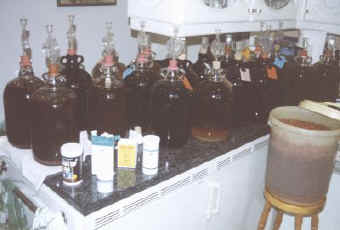 Several
people have asked me how we make our wines so I started this page by firstly
putting together some advice and tips - they assume you have perhaps made a kit
wine and at least understand the basic terms. It has been gradually augmented by
the recipes and specific techniques we have developed as time has gone on and I
am just starting a supporting page with some relevant technical background and
useful facts to help one make a wine of the strength and final specific gravity
(sweetness) one wants. Several
people have asked me how we make our wines so I started this page by firstly
putting together some advice and tips - they assume you have perhaps made a kit
wine and at least understand the basic terms. It has been gradually augmented by
the recipes and specific techniques we have developed as time has gone on and I
am just starting a supporting page with some relevant technical background and
useful facts to help one make a wine of the strength and final specific gravity
(sweetness) one wants.
Since
restarting making wine we have been producing about 4 batches a year, 3 of them
being favourites such as Gooseberry, Blackberry and Morello Cherry with a trial
batch of something different such as Elderflower, Loganberry, Plum, Mixed fruit
and Blackcurrant. We try to keep them for 3 years to mature before bottling and
drinking.
Tips
and the Basics of Winemaking
-
Make
sensible amounts: 4 gallons takes less than double the time that one
gallon takes as all the time is spent in cleaning, sterilising etc the
equipment before and after each stage. Two 4 gallon batches a year gives a
bottle a week for a year.
-
Clean
and sterilise everything: We use Chempro SDP or a similar cleaner for
glassware etc as well as a final rinse with a Sodium Metabisulphite
solution.
-
Freeze
the fruit: Probably the best tip we can give is freeze and thaw the
fruit at least once - several times is even better. It breaks down the cells
allowing the flavour to be extracted by the yeast. It also allows one to
collect enough together for a sensible batch and to be able to blend.
-
Sterilise
the fruit: It is a waste of time cleaning everything if you use dirty
mouldy fruit. I rinse the fruit in a Sodium Metabisulphite solution of two
campden tablets in 2 litres water as it is finishing thawing (leaving it on
the fruit for a couple of minutes) and drain off. I then let it stand with
the residual Sodium Metabisulphite until thawed. This also reduces
oxidation.
-
Crush
the fruit: I hand crush soft fruit and remove what stones I can whilst
it is still in the remains of the Sodium Metabisulphite. With Plums I also
remove some of the skins to avoid a harshness/metallic taste. Apples,
Sultanas and Raisins go in a blender.
-
Do
not leave the fruit standing around: Any fruit will eventually oxidise
(go brown) after it is crushed, especially unripe fruit, until it is
protected by liquid and eventually the Carbon Dioxide blanket and alcohol
from fermentation.
-
Boil
the sugar: I boil in a small amount of water for three minutes to invert
it and sterilise it. I then pour over the fruit to disperse any Sulphur
Dioxide and finish off any remaining wild yeast etc.
-
Choose
how hot you get the fruit: Too much boiling liquid will end up partly
cooking the fruit which extracts extra flavour but gives a more boiled fruit
taste. It also extracts pectin which will make the wine cloudy.
-
Add
pectic enzyme: Add it when the fruit has cooled and leave for a few
hours before adding the yeast if there is a risk of pectin. Plums, apples
and gooseberries can be problems if you get them too hot. Blackberries are
supposed to be a problem but we have not suffered.
-
Use
a starter bottle: I mix up a little yeast with an equal amount of sugar
in warm (having been boiled) water. When it is fermenting I add an equal
volume of the must. I usually divide and add must a couple more times until
I have a couple of wine bottles full of fermenting solution ready to add to
the must when it has cooled and/or the pectozyme has done it's thing.
-
Ferment
on the fruit: I try to make 4 gallons at a time in 5 gallon beer making
tub which has a lid. This gives plenty of space for the fruit to float up to
the surface in the froth of yeast without overflowing. This pulp should be
pressed against the side and pushed down once or twice a day. In between it
is covered over with the lid and protected by the blanket of CO2.
-
Do
not overdo the fermentation on fruit: Too long on some fruit will end up
with too much tannin from the skins which will means it takes years to
mature. 4 days to a week is fine. A good check is when the pulp has become
soft and easy to crush against the side, usually 4-5 days in the summer when
it is warm and a week when colder
-
Do
not ferment on Elderberries: They are full of tannin so remove all the
stalks and boil them in water until the skins dimple - then strain quickly.
Ferment with grape juice (half that when used alone) or raisons to give some
extra body - excellent and drinkable within a few years. Ferment on the
fruit at your peril - the insides of the bottles get plated with a black
layer you can not see through and it needs ten or more years to even become
tolerable.
-
Blend
Elderberries: Better still mix some into other fruit wines to give
flavour and colour.
-
Mixed
Fruit wines: Blends can often be better than there components and come
closest to Grape wines in flavour if that is what you want. Our Stoneberry
is a good example of a blend.
-
Increasing
the Body Add Raisins, Sultanas or even good quality grape concentrate
for more body. A single banana adds a lot of body to a wine such as plum
without a significant taste or bouquet of banana.
-
Add
the sugar in stages: Use 2 to 2.5 kilos sugar for the initial
fermentation on the fruit then add another 1.5 to 2 kilos (boiled and
cooled) after straining off the pulp (assuming 4 demijohns/20 litres are
being made). Leave some head room to add more sugar solution and to prevent
it frothing out through the fermentation traps.
-
Put
sterilising solution in the traps: and also put a piece of cotton wool
or even tissue in the top to avoid flies getting into the trap.
-
Watch
the specific gravity: Every time the Specific gravity drops below 1.000
boil 400 grams of sugar in enough water to give about 500 mls solution,
cool, divide between the 4 jars and swirl well. It is best to extract some
wine and mix before pouring back so it does not sink to the bottom or swirl
the jars before adding.
-
Stop
adding sugar when you have added enough to reach close to the alcohol level
you require and/or the fermentation slows right down. 100 grams sugar per
demijohn gives 1% alcohol and assume about there is about 100 grams
extra from the fruit you use.
-
Rack
as soon as the fermentation has slowed down: and you have added all the
sugar you need (other than a little sugar syrup to compensate for the lost
volume in racking) - now is also the time to reduce the air gap.
-
Keep
records: It is easy to forget how much sugar you have added and given
time how the wine was made and when it was started. Tag all the jars in the
batch.
-
Do
not hurry: Most red fruit wines will take two or three years, one or
more being occasionally racked under a fermentation trap and a year or two
more in the demijohn maturing with a cork bung. You do not need to kill it
with sterilising tablets if you take it slow.
-
Do
not bottle too early: Homemade wine keeps and matures well in bulk. Keep
in Demijohns in a cool dark place with a cork bung to allow it to breath a
little and mature. Some of ours stayed forgotten like that for over ten
years. When you bottle late plastic corks are fine and the wine can be
stored upright. Many of the best vineyards are changing to screw tops to
avoid tainted wines.
-
Clean
bottles immediately for reuse We rinse they bottles a couple of times
and then add a Campden tablet to an inch of water and replace the plastic
cork. Labels are attached with a water based kiddy adhesive so the bottles
are immediately ready for refilling.
Favourite
Recipes (click title below to go
direct to recipe)
Early
Summer Wines
Elderflower
Wine - an experimental two demijohn batch (1999)
It
is really too early to call this a favourite wine as it is the first time we
have made it. Lots of people have however asked why we never make it as it is
one of the classic flower wines. Whilst we were returning home down the Kennet
and Avon in mid June the trees were laden with blooms at every stage of maturity
so we decided we would have a go. We picked and trimmed the last day away and
kept the florets in the fridge loosely packed ready to start the next morning.
In retrospect it would probably have been better not to delay and to have poured
boiling water over immediately and then have store the cooled juice. Our method
follows.
-
Picked
about 50 heads of Elderflowers in the sun and well open.
-
Selected
nice clean open florets and cut them off with scissors.
-
Measured
out 1 litre (shaken down - not compressed) of florets ie 500 mls per 5 litre
demijohn - do not use too many
-
Peeled
rind from 5 lemons (take care to avoid the pith) and chopped up coarsely.
-
Put
Elderflowers in 2 gallon bucket with lemon peel and poured on 6 pints
boiling water.
-
Boiled
1.5 kgs Sugar with 5 litres water for three minutes and added to bucket
-
Poured
3 pints boiling water over 150 grams raisins + 400 grams sultanas and
blended coarsely and added to bucket
-
Squeezed
lemons and added.
-
Allowed
to cool to room temperature (many hours!) and added Pectozyme
-
Left
for 18 more hours and add starter bottle of yeast. Two teaspoons used of CWE
Formula 67 yeast which contains nutrients which are very important for
flower wines.
-
Strained
into two demijohns after fermenting for 3 days - residue only weighed 350
grams so fruit, peel and flowers had been well consumed in the three days
-
Added
another 500 gms sugar (boiled with 1 GM water and cooled to 35 degrees)
giving total so far of 2 Kgs.
-
Topped
up demijohns to 3 cms from the top with boiled and cooled water and inserted
fermentation traps - fermenting very fast!
-
Added
another 250 gms sugar (boiled with 0.5 litre water and cooled to 35 degrees)
after two more days giving total so far of 2.25 Kgs between the 2 demijohns.
With the sugar from the Raisins and Sultanas this should give a dry wine of
about 12.5%.
-
Added
2 teaspoons of grape tannin dissolved in 500 ccs of warm water. This should
have been added earlier but we did not have any available.
-
Racked
off lees after 6 weeks
-
Slight
haze and gravity down to .990 (very dry) after 3 months
-
Bottled
first gallon after 2.5 years
-
Tried
half bottle after 3 years - yellow tint and very flowery, we could use less
elderflowers, but overall much better than we had expected.
Summer
Wines
Dry
Gooseberry (4 demijohn batch 1999 and 2 demijohn batch in 2002)
We
are aiming for a dry wine without any stewed fruit taste. This type of
gooseberry is like an Entre deux Mers and ideal for Moules. We therefore did not
use boiling water but depended on freezing and thawing, a longer fermentation
and pectic enzyme for the extraction. The fruit was soaked in sodium
metabisulphite solution for ten minutes (teaspoon per Modules) and then top and
tailed as soon as each batch was picked in the garden. The batches were then
frozen until the wine was made in early July. They were crushed by hand to break
open each berry as they were added to the fermenting bin - a long job for 8
Kgrams. The detailed description covers the 1999 batch with differences
indicated.
-
4
x 4 litre ice cream tubs (8 kgs) of frozen gooseberries from our own bushes
hand crushed.
-
3
Kilos Sugar boiled and cooled then added to the fruit and made up to 4
gallons with boiled and cooled water
-
Boots
Pectolitic Enzyme added with 2 campden tablets.
-
Starter
bottle of CWE Formula 67 yeast added after 24 hours
-
Strained
and squeezed after 7 days on pulp into 4 demijohns
-
1
Kilo Sugar in solution added.
-
0.5
kilo sugar added after 6 days when fermentation slowed
-
Further
additions (0.4 + 0.5 + 0.4) over next month each time gravity fell to 1.000
up to total of 5.8 kgs
-
Racked
after 10 weeks - very clear with bubbles rising slowly from the lees and
glinting in the sun and so dry at a gravity of .990 it makes me wonder if I
have double booked some of the sugar!
-
Topped
using sugar solution containing .4 kilo sugar (giving total of 1.5 kgs/demijohn).
Medium/Full
Bodied Gooseberry (4 demijohn batch in 2000 and repeated in 2001, 2002 and 2003)
The
description following was repeated in 2001 and 2002. We are aiming for a medium
dry wine with a more obvious Gooseberry taste - this is a wine which we have
made several times before and does not need to be bone dry. We extract more of
the Gooseberry flavour by using boiling water as well as freezing and thawing, a
long fermentation and pectic enzyme. This year the fruit was frozen before
toping and tailing because we were about to go away and some of the fruit was
less ripe than I would have liked. Gooseberries can be cooked when under ripe,
in fact they are best like that as the skins harden as they ripen. I prefer to
wait until the seeds are definitely turning brown for winemaking. The batches
were then frozen until the wine was made in mid July. The fruit was soaked in
sodium metabisulphite solution for ten minutes (one teaspoon or a couple of
campden tablets per tub) when almost thawed and then each berry was toped,
tailed and crushed by hand to break open each berry as they were added to the
fermenting bin - a long job for 8 Kgrams.
We
usually have trouble clearing Gooseberry made using a hot extraction so we use
extra pectic enzyme and leave it longer than usual before adding the yeast. This
seems to work as 6 weeks from start the 2000 wine was very clear with a very
firm sediment and quite drinkable already when racking!
The
2001 had an extra .5 kg fruit and .3 kg sugar and has been very slightly slower
to clear although the gravity was .995 (Note - a calibration error was
discovered on our hydrometer and this was probably more like 1.005). It looks as
if the extra time with Pectic Enzyme works well and at long last we have the
possibility of crystal clear gooseberry wine.
In
2002 we made a 5 demijohn batch with 1.4 kgs added sugar per demijohn. Boots no
longer do winemaking supplies and we now use 4-5 grams of Young's Cellarman
Pectolase enzyme per demijohn (available from Wilkinson's hardware stores in 17
gm tubs).
The
fruit used in 2003 was quite green and we will aim for a drier more acidic wine
to make sparkling or to drink with a meal.
The
method below was that used in 2000 on which the other years was based:
-
8
kgs of frozen gooseberries from our own bushes, topped, tailed and hand
crushed.
-
2.5
Kilos Sugar boiled and added to the fruit and made up to 4.5 gallons with
boiling water - probably hot enough to be sterilising.
-
Cooled
and 40gms Boots pectic enzyme added as the fruit had been heated.
-
After
36 hours a starter bottle of CWE Formula 67 yeast added - we tend to add
half the bottle and top it up with the juice and repeat a couple of times
until the main container is visibly fermenting if we have used campden
tablets.
-
Strained
after 6 days fermenting on pulp into 4 demijohns and 0.75 Kilo Sugar in
solution added.
-
After
2 days fermentation was slowing and gravity down to 1.005 so another 0.75
Kilo Sugar in solution added.
-
After
another 2 weeks fermentation very slow and gravity down to 1.000 and
clearing so another 0.5 Kilo Sugar in solution added. (Total 4.5 kgs Sugar)
-
6
weeks from start the wine was very clear with a firm sediment and
fermentation seemed to have stopped so racked off lees.
Loganberry
(2 demijohn batch 1999, 2002 and 2003)
1999
was the first time we have had enough Loganberries to make wine and we decided
to aim for a dry and fairly light wine - say 12.5% alcohol. The books say you do
not need a very large amount of Loganberries so we went for one kilo per
demijohn - much less than we use for Blackberry. The fermented out cleared
remarkably quickly and was crystal clear when we racked it off the lees after 10
weeks. The sediment was almost solid - the CWE yeast mixture contains both
nutrient and some bentonite which is a clay type finning agent.
-
2
Kgrams frozen Loganberries
-
1
Kgms Sugar boiled and added to the fruit and made up to 1.5 gallons.
-
Cooled,
pectic enzyme and 2 campden tablets added.
-
A
starter bottle of CWE Formula 67 yeast added after 20 hours
-
Strained
after 7 days on pulp into 2 demijohns with another .5 Kgs Sugar in solution.
-
3
batches sugar (0.5 + 0.3 +0.2 kgrams) added at intervals over a month as
gravity fell.
-
Racked
off the lees (a solid sediment under crystal clear wine) 10 weeks after
starting.
-
Demijohns
topped up with a sugar solution as it measured 0.995 and tasted almost too
dry (another 0.2 kgrms sugar) .
-
This
is now about 1.35 kgrms sugar in 5 litres corresponding to about 13%
alcohols - a little higher than we had intended.
Blackcurrant
(2 demijohn batch 2000 and repeat with 3 demijohns in 2001 and 2 demijohns in
2002 and 2003)
We
do not have many Blackcurrant bushes in the garden so this was first made using
some new and some fruit frozen from a previous year. We used a 4 and a 3 litre
tub and aimed for a tasty wine at about 13.5% wine. It fermented out quickly and
was quite clear when we racked it off the lees after 6 weeks and crystal clear
at the second racking a year later with very little extra sediment although it
continued to ferment for as couple of years. On tasting we noted that next time
we should possibly use less Blackcurrants as it was extremely tasty. We
therefore made a batch the following year with the quantities reduced to 4.4 Kgs
Blackcurrants (two tubs) for three demijohns but the same basic method but
returned to the original quantities in 2002 and 2003 but aiming for a higher
gravity and slightly sweeter wine.
-
3.8
Kgrams (7 litres)frozen Blackcurrants thawed overnight and warmed to room
temperature in the microwave.
-
1.5
Kgms Sugar boiled and added to the fruit and made up to 1.6 gallons (sg
1.120).
-
Cooled,
20 gms pectic enzyme and 2 campden tablets added.
-
A
starter bottle of CWE Formula 67 yeast added after 24 hours
-
Strained
after 6 days on pulp into 2 demijohns with another .8 Kgs Sugar in solution
taking back to 1.065 specific gravity.
-
1
extra batch of sugar (0.2 kgrams) when the demijohns were topped up.
-
Racked
off the lees (a solid sediment under clear wine) 6 weeks after starting.
-
Racked
again after another year - crystal clear with a very small sediment. Very
strong varietal taste and still slightly petillant and just off dry so left
under a fermentation trap a little longer. In fact it one demijohn restarted
in the spring 2 years after we started it! On tasting we found that it was
extremely tasty and decided that next time we should use less Blackcurrants
(say 1 - 1.5 kgs per demijohn) as and the quantities we used the first time
seemed more appropriate to a rich sweet "port" wine with some
raisins or bananas added to increase the body.
Plum+
(plus Sultana, Sloe and Banana) 1 demijohn experiment 1996
Plum
is a wine which is difficult to get exactly right. Plum alone is very short in
body and has a slight tang if you make up by using more fruit. The best stoned
fruit are old fashioned Damsons if you can get them and Morello Cherry is of
course a favourite of ours. The accepted logic with Plum is to add Sultanas or
Wheat to Plums to get more body. We have not fancied wheat but have made a few
gallons of plum (from a friends farm) with sultanas. This turned out a wine
which still seemed to lack something for drinking by itself, but made a perfect
base for a punch where the taste and tannin from the skins complemented the
cider, fruit, fruit juice and ginger wine we added. A huge amount went at our
Silver Anniversary party and virtually nobody drank wine (not home made!).
We
have also recently been impressed with the results of a small batch (one
demijohn) of what I have called Plum+ which is very drinkable. It was started
before we initiated this web page so I have less documentation than these days -
the bits in [] were not documented but are my standard practice. The important
points are that we used Victoria Plums (from our own tree) and added sultanas
and a single ripe banana for body. The sloes were looking for a home and were
used to add a little extra taste and colour. We intend to repeat and refine this
recipe again using our Victoria Plums and perhaps adding 5-10% Morello cherries
as well as, or instead of the sloes/bullaces (if not available), sultanas, and a
banana.
-
1.5
lbs frozen Victoria Plums thawed and stoned (weight when stoned?).
-
12
oz Sultanas roughly chopped
-
10
oz Sloes (frozen) from hedgerow (possibly Bullaces as less thorny and bigger
than usual)
-
1
ripe Banana (which gives body without excessive taste).
-
2
lb Sugar boiled and added to the fruit and made up to .8 gallons
-
[Cooled,
pectic enzyme and 1 campden tablets added.] Plum is high in Pectin so pectic
enzyme is essential if boiling water is added.
-
[A
starter bottle of] CWE Formula 67 yeast added [after 24 hours]
-
Strained
[after 5/6 days on pulp] into 1 demijohn with another 6 oz Sugar in solution
added.
-
Racked
off the lees about 8 weeks after starting.
-
Racked
again after 2 years and sealed for storage. Already crystal clear and
drinkable.
-
Bottled
after another year (3 years from starting)
-
6
years from starting it is a very acceptable and well balanced fairly light
wine. By now one needs considerable imagination to know there was banana
present.
Autumn
Wines
Blackberry
with Elderberry (4 demijohn batch) 1998
-
6
Kgrams frozen Blackberries
-
75
grams of Elderberries (boiled and strained) for colour and a bit of Tannin
-
3
Kilos Sugar boiled and added to the fruit and made up to 4 gallons with
boiling water.
-
Cooled
and a starter bottle of CWE Formula 67 yeast added
-
Strained
after 5 days on pulp into 4 demijohns
-
1
Kilo Sugar in solution added.
-
3
x 0.5 kilo sugar added at 3-7 day intervals when gravity fell below 0.998.
-
racked
when fermentation stopped, topped up with diluted sugar solution (4oz/pint)
-
No
sign of extra fermentation when summer came and very clear so racked off the
lees and the fermentation traps replaced by corks.
-
One
campden tablet added to stabilise the wine as it is medium dry (1.005).
-
Almost
drinkable (after 8 months) but we will leave it in the demijohns in a cool
place for another year at least before bottling
Medium
bodied Blackberry (4 demijohn batch 1999)
This
was made predominantly with this years Blackberries from our own garden and
frozen then slowly thawed to break down the fruit.
-
12
litres (7 Kgrams) frozen Blackberries
-
3
Kilos Sugar boiled and added to the fruit and made up to 4 gallons with
boiling water - probably hot enough to be sterilised this time.
-
Cooled
and 8 campden tablets and pectic enzyme added as the fruit had been heated.
-
After
16 hours a starter bottle of CWE Formula 67 yeast added - we tend to add
half the bottle and top it up with the juice and repeat a couple of times
until the main container is visibly fermenting if we have used campden
tablets.
-
Strained
after 6 days on pulp into 4 demijohns - the 7 kilos fruit had reduced down
to under 1.5 kilos dry pulp.
-
1
Kilo Sugar in solution added - gravity 1.060 and a very vigourous
fermentation almost reaching the trap.
-
Another
600gms sugar added after a fortnight when the gravity had fallen to 1.005
-
Racked
after another 6 weeks at 0.995 and clear.
-
The
wine was topped up with a boiled and cooled solution containing 400gms of
sugar (total sugar 1.25 kgs/demijohn) and left to hopefully ferment a little
more.
Medium/Full
bodied Blackberry (4 demijohn batch in 2000 repeated in 2001 and a two demijohn
batch in 2003)
This
was made predominantly with 2000 year Blackberries from our own garden and from
Jo and Adrian's farm, frozen then slowly thawed to break down the fruit. I
started with the intention of making a five demijohn batch but decided to make
it a bit richer so strained into 4 demijohns. It was so promising that the
recipe here was repeated almost exactly in 2001 except we used less campden
tablets - even then it was slow to start. The 2003 batch was two gallons and
started life on the boat with us.
-
13.5
litres (8.5 Kgrams) frozen Blackberries
-
3.5
Kilos Sugar boiled and added to the fruit and made up to 4.5 gallons with
boiling water.
-
Cooled
and 8 (reduced in 2001) campden tablets and pectic enzyme added as the fruit
had been heated.
-
After
16 hours a starter bottle of CWE Formula 67 yeast added - we always tend to
add half the bottle and top it up with the juice and repeat a couple of
times until the main container is visibly fermenting if we have used campden
tablets. This time it took 2 days to start fermenting - 8 campden tablets
were obviously too many - we will use 4 or 5 in the future
-
Strained
after 5 days on pulp into 4 demijohns - the 8.5 kilos fruit had reduced down
to under 2 kilos dry pulp.
-
500gms
Sugar in solution added and a very lively fermentation at 1.022.
-
Another
600gms sugar added after a day when the gravity had fallen to 1.011
-
Another
400gms sugar added after two more days when the gravity had fallen to 1.000
(5 kgs total or 1.25 kgs/demijohn sugar in 2000)
-
Racked
after about 10 weeks - the 2001 batch was crystal clear and under .990
gravity so a little extra sugar (0.4 kgs) in solution added when topping up
to total of 1.3 kgs/demijohn) .
Canalside
Blackberry (2 demijohn batch 1999)
This
was made with Blackberries picked on the towpath and overhanging the canal in
late August. They were frozen in the fridge on the boat in batches. The sugar
and water was not hot enough to sterilise the fruit so Campden tablets were also
used. We had no pectic enzyme otherwise it would have been used although the
temperature had only reached about 50 degrees Centigrade.
-
7
litres frozen Blackberries (approx 4.5 kgs)
-
1.7
Kilos Sugar boiled and added to the fruit and made up to just under 2
gallons with boiling water.
-
Cooled
and 4 Campden tablets to complete sterilisation
-
Starter
bottle of CWE Formula 67 yeast added after a day.
-
Strained
after 6 days on pulp into 2 demijohns with .7 Kilo Sugar in solution added.
-
Another
0.4 kilo sugar in solution added after 7 days and topped up to near top of
demijohn as fermentation had abated - we are aiming for a full bodied medium
wine but the gravity after sugar was 1.055 a bit high at that time - it is
better to add in smaller amounts as the gravity falls .
-
The
wine was racked after two months when the gravity was down to 0.995 and the
wine was clear with a thick deposit.
-
The
wine was topped up with a boiled and cooled solution containing 200gms of
sugar (total sugar 1.5 kgs/demijohn as we are aiming for a full bodied wine
which does not want to be too dry).
The
end result is everything we hoped - not a wine to share!
Black
Cherry (4 demijohns in 1998 and 5 demijohns in 1999, 2000, 2001, 2002 and 2
demijohns in 2003)
We
have a large and often prolific Morello cherry tree and we are looking for a
staple wine. We are aiming at wine which is not bone dry to complement the
flavour of the cherries.
The
description below is for the 1998 wine but we repeated almost exactly with a 5
demijohn batch in 1999 - again it proved slow to complete the fermentation and I
wonder if the fruit has more sugar itself than I realised. In 2000 I measured
the gravity of the must and it was equivalent to another 200 gms sugar per
demijohn - no wonder it is so strong and difficult to ferment to dry! Start with
3 kgs sugar rather than 4 Kgs in a 4 demijohn batch and add in more stages
All
that follows is for the 4 demijohn 1998 batch
-
4
x 4 1900s ice cream tubs (10 kgs) of frozen Morello Cherries from our own
tree hand crushed
-
4
Kilos Sugar boiled and added to the fruit and made up to 4 gallons with
boiling water
-
Cooled
and Boots Pectolitic Enzyme added
-
Starter
bottle of CWE Formula 67 yeast added after 12 hours
-
Strained
after 6 days on pulp into 4 demijohns
-
1
Kilo Sugar in solution added.
-
0.5
kilo sugar added after 14 days when gravity fell to 1.005
-
Racked
when fermentation stopped, topped up with diluted sugar solution (4oz/pint)gravity
a bit high still at 1.008 rather than 1.003-1.005 aimed for .... will it
start to ferment again?
-
Yes
it did - fermenting very slowly as summer came.
-
Racked
in mid June after 9 months - looks very nice and clear.
-
First
gallon bottled in after 21 months - still medium but it has plenty of body
and the taste of cherry to go with it. Crystal clear and deep red colour.
A
wine to repeat and repeat and repeat!
Mixed
Fruit I (2 demijohn batch in 1998)
-
1
x 4 litre ice cream tub Raspberries (frozen and thawed)
-
1
x 4 litre ice cream tub Black Cherries (frozen and thawed)
-
0.6
x 4 litre ice cream tub Blackberries (frozen and thawed)
-
150
grams wild black plums
-
1.5
Kilos Sugar boiled and added to the fruit and made up to 2 gallons with
boiling water.
-
Cooled
and Boots Pectolitic Enzyme added
-
a
starter bottle of CWE Formula 67 yeast added after 24 hours
-
Strained
after 5 days on pulp into 2 demijohns
-
660
grams sugar in solution added.
-
340
grams sugar added when gravity fell to 1.000 ( took 14 days)
-
250
grams sugar added when gravity fell to 0.995 (took 14 days)
-
Racked
when fermentation stopped, topped up with diluted sugar solution (4oz/pint)
-
No
sign of extra fermentation when summer came and it looks very clear so
racked again and the fermentation traps replaced by corks.
-
One
campden tablet added to stabilise the wine as it is medium dry (1.005).
-
It
was almost drinkable at this time (8 months) but we will leave it in the
demijohns in a cool place for another year at least before bottling.
Mixed
Fruit II (4 demijohn batch in 2002)
This
is very typical of a mixed fruit wine made whilst clearing out old fruit etc
from the freezer to make space for another years crop. It was made almost
precisely by, what I regard as my standard method, so I have described it more
fully than usual as a model to be followed. The total fruit is about my standard
measure of one ex ice cream tub of frozen fruit per demijohn. Each tub of fruit
was covered in a sterilising solution of 2 campden tablets in a litre of water
when almost thawed for circa 5 minutes and the solution poured into the next
tub. The fruit was then hand crushed and/or stoned. The wild plums were a
mixture of bullaces and sloes picked in Guernsey and were too small and hard to
stone so were just broken open and crushed by hand. When completed it was
covered with sugar solution which had been boiled for 3 minutes and made up to
about 4.5 litres for each demijohn with more boiling water. This leaves room for
the foam and crust during fermentation in the "bucket". This is cooled
overnight prior to adding 4-5 grams Pectolase and one campden tablet per
demijohn being made. This removes any pectin and completes the sterilisation.
Here
it deviates slightly from the standard method as it started as a 3 demijohn
batch but an extra tub of cherries covered in boiling sugar solution was added
after it had been cooling overnight to give it a bit more colour and flavour and
make it up to a four demijohn batch. The elderberries were also added for colour
and a little "bite" and in their case they were boiled with a little
water until they dimpled and only the juice was used after sieving and a further
short boil - elderberries can add all sorts of undesirable life and need to be
well sterilised.
The
Must stood with Pectolase for a day and a starter was prepared and then
"multiplied" by doubling the volume with Must repeatedly until there
was 3 litres fermenting. I use Formulae 67 yeast which has added nutrients and a
small amount of Bentonite (a clay based fining agent) at the rate recommended
for starting a gallon (5 grams per demijohn) so the finning and nutrient is at
the correct level rather than using the same starter regardless of batch size as
they recommend. The initial starter has 5-10 grams sugar plus the yeast in 250
ccs boiled water cooled to circa 35 deg C. Each "doubling" takes
between half and one hour to start vigourous fermentation ready for the next
doubling.
In
this case my standard of approximately half the intended sugar was in the must
but the fermentation was so vigourous that checks showed the gravity was down to
zero after 4 days. I like to ferment on the fruit for 5 - 6 days to extract
flavour and colour. An additional 500 grams of sugar was added to keep it going.
By day five the pulp was very soft as the fruit had now been completely broken
down by the enzyme and yeast so it was strained through a nylon straining bag
which was then squeezed until the pulp was dry and crumbly - even with the
stones it only weighed two kilos.
The
sugar was added in stages in a very typical manner and timing, initially to the
intended 1,400 grams per demijohn (for 15% medium dry wine) and then an extra 50
grams per demijohn added to keep it in the dry/medium dry range of 1.000 to
1.005. This point took 3 weeks from fermentation starting.
-
1
x 4 litre ice cream tub Blackberries (frozen and thawed)
-
1
x 4 litre ice cream tub Black Cherries (frozen and thawed)
-
1
x 4 litre ice cream tub Victoria Plums (frozen and thawed)
-
2.5
litres wild black plums with stones (frozen and thawed)
-
650
gms Red Currants (frozen and thawed)
-
100
grams Elderberries (frozen and thawed)
-
All
the fruit hand crushed and the Cherries and plums stoned.
-
The
elderberries boiled in a little water until dimpled and the juice strained
off and added to the must.
-
2
Kilos Sugar boiled and added to the fruit and made up to 4 gallons with
boiling water.
-
Cooled
and 18 grams Young's Pectolase Enzyme and 4 campden tablets added
-
a
starter bottle of CWE Formula 67 yeast progressively multiplied and added
after another 24 hours.
-
0.5
Kilos Sugar boiled, cooled and added to the fermentation after 4 days as it
was down to 1.000 gravity
-
Strained
after 5 days fermenting on pulp into 4 demijohns and 1.5 kgrams sugar in
solution added.
-
800
grams sugar in boiled solution added when gravity fell to 1.010 (took 2
days)
-
800
grams sugar in boiled solution added when gravity fell to 0.005 (took 7
days)
-
200
grams sugar in boiled solution added when gravity fell to 0.098 (took 7
days) - level now just below neck of demijohn.
-
Racked
off lees after another 11 days (5 weeks from starting) and topped up with
boiled water - very firm sediment and hardly any losses.
Stoneberry
(4 demijohn batch in 2002 and 5 demijohns in 2003) based on a 1997 wine
This
is based on a wine made in 1997 made from Victoria Plums, Morello Cherries and
Blackberries (2:1:1 ratio). The name came about because it was a mix of stoned
fruit and berries. The original 1997 Stoneberry was very successful but made
before documentation on the web site was started. My writen notes show I used
the same methods I now use (frozen fruit stoned/crushed, sterilised with NaMet
and then boiling sugar solution poured over it) and a few
"improvements" have been made based on our other experiences with plum
wines such as the Plum+ described earlier. The aim is for a slightly cleaner and
more full bodied wine than the 1997.
In
2002 the fruit was hand crushed and/or stoned after freezing and thawing. This
time the plums were also skinned to reduce the tannin and improve the flavour -
the skins mostly just fell off after freezing. A banana was added to increase
body which plums lack and a small number of blackcurrants were added to give
more colour and a touch of flavour which again the plums lack, especially when
skinned. The 2003 was very similar except that the banana was omited and a small
number of loganberries were added to give body and bouquet.
-
1
x 4 litre ice cream tub Blackberries (frozen and thawed)
-
1
x 4 litre ice cream tub Black Cherries (frozen and thawed)
-
2
x 4 litre ice cream tub Victoria Plums (frozen and thawed)
-
1
litre Black Currants (frozen and thawed)
-
1
ripe Banana
-
All
the fruit hand was crushed and the Cherries and Plums stoned.
-
The
plums were mostly skinned to reduce the tannin and improve the flavour.
-
2
Kilos Sugar boiled and added to the fruit and made up to 4 gallons with
boiling water.
-
Cooled
and 18 grams Young's Pectolase Enzyme and 4 campden tablets added
-
A
starter bottle of CWE Formula 67 yeast progressively multiplied and added
after another 24 hours.
-
1
Kilos Sugar boiled, cooled and added to the fermentation after 3 days as it
was down to 1.000 gravity.
-
Strained
after 4 days fermenting on pulp into 4 demijohns and 1.3 kgrams sugar in
solution added. The demijohns were almost full as there was very little pulp
after straining (only 1.5 kgs total)and the fermentation still very
vigourous
-
500
grams sugar added when gravity fell to 0.992 and fermentation slowed (11
days from starting) - level now at neck of DJ and SG 1.000.
-
Racked
off lees after another 11 days (5 weeks from starting) and 800 grams sugar
in boiled solution added - very firm sediment and hardly any losses.
-
Further
200 grams sugar added at next racking as it was at a gravity of 0.992 (too
dry) bringing total sugar to 1.4 kgs/demijohn - circa 15.0% alcohol
Home
|